

Carbon Computing Standard
Agriculture, a cornerstone of the Indian economy, accounts for 18% of the country’s Green House Gas (GHG) emissions due to the use of machinery, synthetic fertilizers, crop protection chemicals, and fuel. The Agriculture Carbon Footprint Assessor (ACFA Version 1.0) is the first comprehensive, indigenous Carbon Footprint Assessment Standard tailored for Indian agricultural conditions, addressing the need to quantify and assess the carbon footprint of agricultural practices for sustainable development. Developed through the IBM-IORF Sustainability Accelerator Project and supported by scientists from various Indian research institutes and universities, ACFA Version 1.0 draws upon international guidelines such as the IPCC guidelines, GHG Protocol Agricultural Guidance, ISO 14064-1, and PAS 2050.
The Sustainable Agriculture Carbon Footprint Assessment (SACFA) Toolkit, created by i-NoCarbon Limited, UK, operationalizes ACFA Version 1.0, helping evaluate the sustainability of agricultural practices and contributing to climate change mitigation. This toolkit is essential for guiding sustainable agricultural systems and promoting climate-friendly practices in India.
ACFA Version 1.0: Effort to make a Carbon Assessment Tool in India for Measurement of GHG Emission / Mitigation in Agriculture for Indian Ecosystem(An Evaluation Protocol based on “2019 Refinement to the 2006 IPCC Guidelines for National Greenhouse Gas Inventories” and latest IPCC Assessment Report 6 (AR6), released in August 2021).
This is probably the 1st comprehensive carbon computing tool for assessing Agricultural Sustainability, developed by Indian Scientists considering conditions in Indian Ecosystem viz. diversity in agro-ecosystem, variation in cultivation practice, on-farm and off-farm input usage pattern, energy usage, residue management and transport.
ACFA v1.0 - The First Comprehensive, Indigenous Carbon Footprint Assessment Standard

Carbon Footprint - A Key Indicator of Agricultural Sustainability
Agriculture sector contributes to GHG emissions through energy use in the production and use of farm machinery, synthetic fertilizers, and crop protection chemicals such as herbicides, insecticides and fungicides and by direct use of fuel in farm operations. Moreover, GHG driven changing climate is adding to the environmental woes. Under such complex situations, firstly, it becomes very important to quantify and assess the carbon footprint associated with each management activity in crop production. Relative sustainability of agronomic production determined by their C-footprint is ultimately the indicator of agricultural sustainability. The higher the C-footprint, lesser the agricultural sustainability is. Therefore, evaluating agronomic production based on their carbon footprint provides valuable insights into their environmental, social, and economic sustainability, guiding efforts towards more sustainable agricultural systems.
Agriculture is an important sector of the economy in India, contributing about 20% of national gross domestic product, and providing a livelihood for nearly two-thirds of the population (ICAR, 2015). Equally important is the contribution of agriculture to national food security. The Green Revolution (GR) enabled India to attain self-sufficiency in food production, but its unsustainable practices led to soil degradation, environmental pollution, and ecological imbalances, highlighting the need for more sustainable agricultural approaches.
Increased use of production inputs, such as chemical fertilizer, has made Indian agriculture more greenhouse gas (GHG)-intensive. Agricultural production is a major emitter of GHGs, currently accounting for 18% of total GHG emissions in India (INCCA, 2010). Recent estimates report that global food production must increase by 70% to meet the projected food demand of the estimated 9 billion global population by 2050 (CTA-CCAFS, 2011). With a population of ∼1.3 billion, it is evident that the food system in India will be central to the global challenge of providing sufficient nutritious food while minimizing GHG emissions.
The Agriculture Carbon Footprint Assessor (ACFA Version 1.0) is a pioneering Carbon Footprint Assessment Standard designed specifically for Indian agricultural conditions. It takes into account the unique diversity of Indian agro-ecosystems and provides a comprehensive framework for calculating emissions and identifying opportunities for GHG mitigation. ACFA ver. 1.0 draws upon international guidelines such as the IPCC guidelines, GHG Protocol Agricultural Guidance, ISO 14064-1, and PAS 2050 while emphasizing a qualitative approach to agricultural management.
During the IBM-IORF Sustainability Accelerator Project, Inhana recognized the need for effective computation and assessment standards for carbon footprints in agriculture, particularly within the Indian context where such standards were lacking. With the active support of scientists from several research institutes and universities, including Visva Bharati University, Bidhan Chandra Krishi Viswavidyalaya (BCKV), University of Calcutta, Indian Statistical Institute (ISI), and Nadia Krishi Vigyan Kendra, BCKV, ICAR, Inhana outlined the Agriculture Carbon Footprint Assessment Framework and the Agriculture Carbon Footprint Assessor (ACFA Version 1.0) was developed as the first comprehensive, indigenous carbon footprint assessment standard specifically for Indian agriculture within the ambit and support from IBM-IORF Sustainability Accelerator Project.
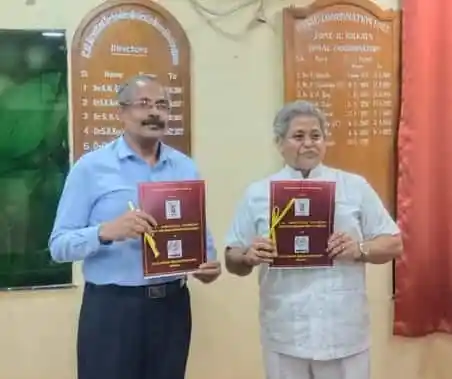
MoU with ATARI, ICAR, Zone-V
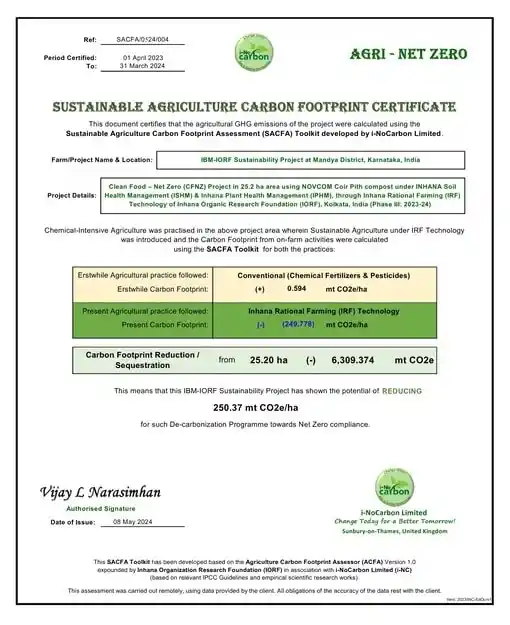
The SACFA Toolkit - Putting ACFA Into Action
How ACFA v1.0 Different From Other Carbon Accounting System
Most of the current available agriculture carbon foot print assessment tools developed so far; calculate the GHG footprint of conventional agricultural practices. These tools often employ simplified models, specifically Tier 1 methods as per IPCC guidelines, which rely on default emission factors and readily available activity data. While easier to apply, these methods may not capture specific details, leading to less accurate estimates. They have a limited scope for alternative inputs used in sustainable agriculture, such as compost, which is typically represented by default values for on-farm and outsourced production. Additionally, these calculators often overlook certain emission sources, like embodied GHGs, and rely on assumptions or default values due to the lack of specific data, resulting in potentially unreliable results. Furthermore, they may not adequately account for regional variability in agricultural practices and emissions, which can vary significantly with geographical location, climate, and other micro-climatic factors.
Agriculture Carbon Footprint Assessor (ACFA ver 1.0) is more advanced in terms of measuring carbon footprint of different aspects of sustainable agriculture considering the latest IPCC guidelines and related research findings in India. The major differences are:
- Considered ALL THE POSSIBLE alternative Specific Input components under these calculations.
- ACFA (Ver 1.0) considered not only quality but qualitative variation of organic manure/compost on carbon sequestration potential and calculate carbon footprint accordingly.
- Source point emission/mitigation from soil resource recycling under different methodology was taken under calculation as per IPCC guideline (generally ignored).
- Carbon footprint values from different sustainable/ alternate inputs (used in Indian agriculture) were developed with best possible rational and taken into consideration.
- Agro-climatic variation in Paddy methane generation, soil carbon sequestration has been taken based on Indian Research work.
- Algometric equations for biomass calculation are based on India specific work along with considering regional variation.
- Embodied energy for all farm machinery use has been considered (which was mostly ignored).
- Calculation of carbon footprint from chemical pesticide, it was calculated individually based on standard protocol (which was mostly ignored).
- The tool covers calculation from almost all types of nutrients used in Indian Agriculture.
- Most significantly, ACFA (Version 1.0) is probably the 1st one which incorporates a two-value approach, which indicates the effect over two different time horizons, is suggested by a number of studies in case of CO2 and CH4 to find out more realistic carbon footprint as also indicated In the Sixth Assessment Report of IPCC (AR6) which said multi-basket approaches have many precedents in environmental management, including the Montreal Protocol.
- In the ACFA-Version 1.0, qualitative approach rather than quantitative application in agricultural management system and crop sustainability was given major emphasis while developing the standard.
- At the same time impact of sustainable technology for both soil and plant health management has been recognized under the newly developed standards.
- Provision for inclusion of carbon footprint from seed is incorporated.
- Scope for measuring carbon footprint from other associated activities like office work, storehouse, food etc. has also been included.
- Most importantly it is a most dynamic standard where there is scope of inclusion of new findings/area specific findings (Tier 3 data) to calculate the carbon footprint in most specific way.
- There is provision to include carbon emission/mitigation opportunities regarding different sustainable /regenerative practice for soil health management.
- There is inclusion of comparatively more Tier 2 & Tier 3 data and options for inclusion of site specific emission factor.
In collaboration with ATARI, ICAR, Kolkata (Zone-V), led by Dr. P. Dey, Director and renowned soil scientist and Dr. Ranjan Bera, Chief Scientist, along with other Technical Managers of IORF, ACFA version 2.0 was developed in 2024 with more India specific tier 3 data base and field specific information for more realistic carbon computing suitable for versatile Indian Ecosystem. ACFA (version 2.0) was developed, with consideration of India specific, Tier 3 level data base and field specific information, to enable more realistic carbon computing, suitable for the versatile Indian Agriculture scenario. System boundary that includes all possible area of emission/mitigation within the farm/ areas under the study was aligned with SBTI FLAG Guidance (Anderson et al, 2022). The background emission factors (EFs) used by ACFA (version 2.0) meets the standard norms and is compliant with PACT v2 (WBCSD, 2023).
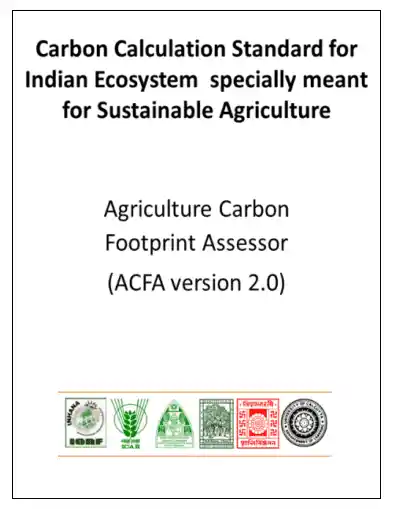
ACFA Version 2.0 & Development of Carbon Computing Tool For Tea
ACFA version 2.0 has been developed in 2024 with more India specific Tier 3 data base and field specific information for more realistic carbon computation suitable for versatile Indian Agro-Ecosystem. ICAR-ATARI (Zone-V), Kolkata joined hands with IORF for further development of ACFA with the signing of a Memorandum of Understanding (MoU). At the same time Trustea Sustainable Tea Foundation (TSTF) was in search for a comprehensive, conclusive carbon footprint assessment tool, appropriate for Indian Tea Ecosystem to calculate process GHG Emissions while also taking into account the Net C-Sequestration, Mitigation, Abatement and Offsetting aspects of the Indian tea plantations; to quantify the Net C-footprint of existing as well as post interventions from Cradle to Gate. Considering the comprehensiveness, completeness, scientific interpretation and most importantly the consideration of quality components of the interventions for the mitigation and sequestration towards the impact on sustainability fascinated them more. Accordingly ACFA Version 2.0 incorporated all micro and macro emission sources which are different and conclusive for tea industry also to make it most authenticated Tea Specific Standard.
This led to its collaboration with IORF, as the Technology partner, and a MoU was signed between the two organizations for the development of a comprehensive tool for capturing all Carbon Footprints within the system boundary with India specific Tea Ecosystem. The alliance has brought forth the Trustea Emission Calculator (TEC) based on ACFA version 2.0. It’s Basic and advanced version will be free to use and demonstrate results for in-house carbon computing and education/ research purpose. TEC (pro-version) will be restricted for carbon computing towards official carbon reporting and certification for the licensed users only.
Thus the “TEC Toolkit” has been developed based on the Agriculture Carbon Footprint Assessor (ACFA) Version 2.0 expounded by Inhana Organic Research Foundation (IORF) and ICAR-ATARI, Kolkata (Zone-V) in association with i-NoCarbon Limited (i-NC), UK (based on relevant IPCC Guidelines and empirical scientific research works). At the same time TEC probably the 1st ever Carbon Computing Tool for carbon assessment in tea sector considering the agro-ecological variability of Indian tea agro-ecosystem as well as diversities in the management and alternate input usage. This tool kit is a hybrid module which need both audit and analysis based dataset for final carbon calculation. Advanced version of TEC Tool highlights the relationship between carbon and sustainability indices and helpful for Sustainability SWOT study of any tea estate or small tea grower’s farm. At the same time, the analytical output from the ‘TEC Toolkit’ will help to develop Regenerative farming models along with management policies towards reduction of carbon footprint of the tea while infusing sustainability components.